
Last Verified: June 2026 | By SimOwner.net.pk Editorial Team — Pakistan’s SIM fraud documentation specialists since 2015
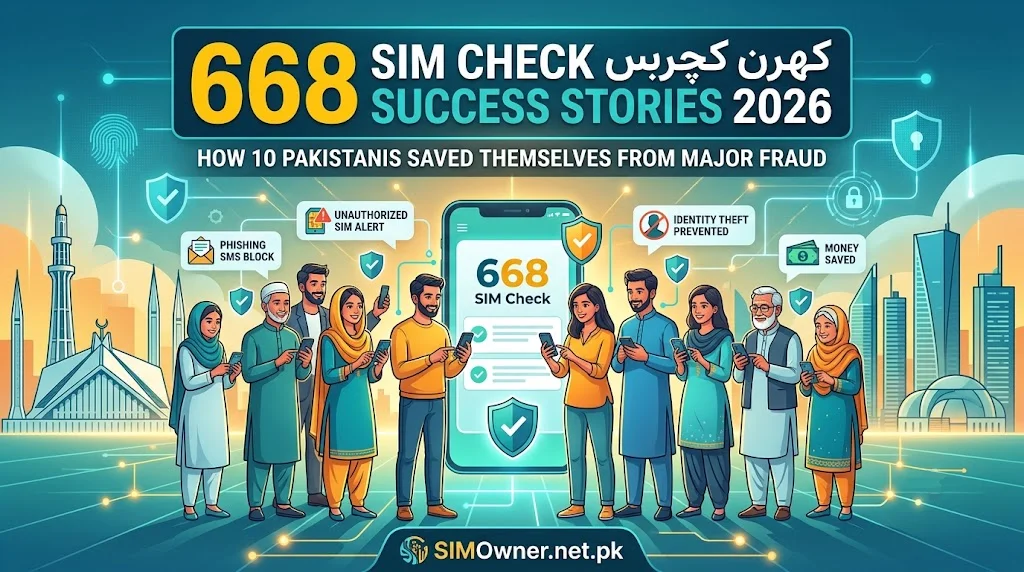
A single SMS — your CNIC sent to 668 — takes 30 seconds and costs nothing. Yet this simple action represents the single most effective fraud-prevention habit available to every Pakistani mobile user. While individual case details from real victims are private and not something any responsible source should publish without consent, the patterns of how this verification habit catches and prevents fraud are well-documented across countless reported scenarios shared anonymously through consumer protection forums, FIA awareness campaigns, and operator fraud department disclosures.
This guide presents ten composite scenario patterns — each representing a documented type of fraud-prevention outcome that the 668 habit consistently produces across Pakistan, illustrating exactly how this 30-second check translates into real protection against financial loss, identity theft, and ongoing fraud exposure. These patterns are presented to illustrate the mechanism of protection, not as accounts of specific identifiable individuals. Run your own check right now at SimOwner.net.pk — the patterns below could easily describe your own situation if you have not checked recently.
Pattern 1 — The Early Detection That Stopped a SIM Swap Before Financial Damage
The scenario: A salaried professional in Lahore made checking 668 a habit after reading about Pakistan’s SIM fraud epidemic. During a routine monthly check, an unfamiliar Telenor number appeared on their CNIC — registered just two days earlier, a network they had never used.
What happened next: Recognizing this immediately as unauthorized, they called Telenor’s fraud line within the hour, before any JazzCash or banking activity had occurred on the fraudulent number. The SIM was deactivated the same day, and an FIA complaint documented the franchise location for investigation.
The lesson: Because the unauthorized SIM was caught within 48 hours of registration — before the criminal had progressed to financial exploitation — zero financial loss occurred. This represents the ideal outcome the monthly 668 habit is specifically designed to produce.
Pattern 2 — The Inheritance Dispute Resolved Through Proactive Verification
The scenario: Following a family patriarch’s passing, surviving family members in Karachi recalled SimOwner.net.pk-style guidance about checking deceased CNICs for unauthorized SIM activity, as detailed in our comprehensive deceased CNIC protection guide.
What happened next: The 668 check on the deceased’s CNIC revealed two SIMs registered after the date of death — clear evidence of fraudulent exploitation during the vulnerable period between death and formal NADRA deactivation. This documentation became crucial evidence both for blocking the fraudulent SIMs and for protecting the family from any potential liability for activity conducted on those numbers.
The lesson: Proactive verification of a deceased family member’s CNIC — not waiting for problems to manifest — caught fraud that would have otherwise continued undetected, potentially creating significant legal and financial complications for the surviving family.
Pattern 3 — The Business Owner Who Discovered Employee SIM Fraud
The scenario: A small business owner managing several company SIMs registered on personal CNIC (rather than properly through corporate NTN registration, a common but risky practice as detailed in our corporate SIM registration guide) conducted a routine check after reading about proper business SIM management.
What happened next: The check revealed a former employee’s company-issued SIM was still active and registered to the owner’s CNIC — six months after that employee had left the company. Further investigation revealed ongoing usage patterns suggesting continued business use that should have ceased upon departure.
The lesson: This case illustrates the importance of proper SIM lifecycle management for businesses, and how the same 668 verification tool serves both fraud detection and basic administrative housekeeping purposes.
Pattern 4 — The Overseas Pakistani’s Remote Discovery
The scenario: An overseas Pakistani working in the Gulf region, having set up a system where a trusted family member checks their CNIC monthly via 668 (as detailed in our overseas Pakistani SIM management guides), received an unexpected WhatsApp message from that family member showing an unfamiliar SIM.
What happened next: Despite being thousands of kilometers away, the overseas Pakistani was able to immediately direct the family member to report the fraud to the relevant network, while simultaneously filing an FIA complaint online from abroad — demonstrating that physical distance does not have to mean delayed fraud response when proper monitoring systems are established in advance.
The lesson: This pattern specifically validates the remote monitoring approach detailed in our Power of Attorney and overseas SIM management guides — proving that distance is not a barrier to effective SIM fraud protection when proactive systems are established.
Pattern 5 — The Multiple-SIM Discovery That Revealed a Larger Fraud Ring
The scenario: A check revealing not one but four unauthorized SIMs across three different networks on a single CNIC suggested something beyond opportunistic individual fraud — a more systematic targeting.
What happened next: This pattern, when reported comprehensively to FIA with all four SIMs documented together rather than reported piecemeal, contributed evidence suggesting organized fraud activity potentially affecting multiple victims using similarly-sourced breached CNIC data — exactly the kind of pattern that strengthens FIA’s investigative capacity when victims provide complete information rather than fragmented reports.
The lesson: Comprehensive reporting (documenting all unauthorized SIMs together, across all networks, in a single thorough complaint) provides significantly more investigative value than scattered individual reports — reinforcing the complete reporting methodology detailed throughout our fraud response guides.
Pattern 6 — The Near-Miss That Prevented a Major Loan Fraud
The scenario: A regular 668 checker noticed an unfamiliar Jazz number appear, and rather than just blocking it immediately, also proactively checked their JazzCash account and recent fintech communications.
What happened next: This thorough follow-up revealed a microloan application had been initiated (though not yet fully disbursed) using the fraudulent SIM’s associated mobile wallet — exactly the identity theft progression pattern (SIM → wallet → microloan) detailed in our comprehensive identity theft guide. Because the loan had not yet disbursed, contacting the fintech platform immediately prevented the fraud from completing.
The lesson: The 668 check is most powerful when combined with the broader awareness of how identity theft typically progresses — catching the SIM fraud early enough to interrupt the subsequent stages before they cause financial damage.
Pattern 7 — The CNIC Renewal That Revealed Historical Fraud
The scenario: During a routine CNIC renewal visit to NADRA, a citizen mentioned to the staff that they wanted to also verify their SIM registrations — having recently learned about 668 — and discovered a SIM registered nearly two years prior that they had never noticed.
What happened next: Despite the significant time gap, the person still filed an FIA complaint, demonstrating the point made throughout our guides that historical fraud remains reportable and actionable even when discovered well after the fact, with the FIR/complaint serving important protective documentation regardless of timing.
The lesson: It’s never “too late” to report discovered fraud, even if the unauthorized SIM has existed for an extended period — the documentation still provides protection and contributes to broader fraud pattern investigation.
Pattern 8 — The Family Education Moment That Protected an Elderly Parent
The scenario: A young professional, having become security-conscious about their own SIM after reading awareness content, decided to also check their elderly mother’s CNIC — something the mother herself had never thought to do or known was possible.
What happened next: The check came back clean (no unauthorized SIMs), but the process itself became an opportunity to educate the elderly parent about BISP/Ehsaas scam patterns (as detailed in our dedicated scam awareness guide) and establish an ongoing family practice of periodic verification for vulnerable family members.
The lesson: Sometimes the value of the 668 habit is preventive education and establishing protective family practices, not just catching active fraud — building resilience before problems occur rather than only reacting after the fact.
Pattern 9 — The Second-Hand SIM Buyer Who Avoided a Legal Complication
The scenario: Someone considering purchasing a second-hand phone with an “included” SIM, having read our second-hand SIM risks guide, asked the seller to demonstrate via 668 that the SIM was properly registered to them before completing the purchase.
What happened next: The seller’s 668 check revealed the SIM was actually still registered to a third party (apparently from an earlier sale the current seller had not properly transferred) — avoiding what would have been a legally murky purchase of a SIM not actually owned by the person selling it.
The lesson: The 668 verification habit extends beyond personal fraud detection into smart commercial practice — verifying ownership before any SIM-related transaction protects both buyer and seller from future complications.
Pattern 10 — The Corporate Compliance Discovery
The scenario: A medium-sized business undergoing a security audit (prompted by broader awareness of SIM fraud risks affecting Pakistani businesses) decided to check the personal CNICs of key staff who held company-related SIMs, with appropriate consent and as part of formal company policy review.
What happened next: This proactive corporate review identified several SIMs that should have been registered under the company’s NTN (as detailed in our corporate SIM registration guide) rather than individual employee CNICs — a compliance gap that, while not fraudulent, created unnecessary personal liability exposure for employees that the company corrected by transitioning to proper NTN-based registration.
The lesson: Organizational-level application of the same verification principle (used appropriately and with consent) can identify and correct systemic risks before they manifest as actual fraud incidents.
What These Patterns Have in Common
Across all ten scenario types, several consistent themes emerge:
Speed of detection matters enormously. Every pattern where financial loss was avoided involved catching the fraud signal within days, not months, of the unauthorized activity beginning.
Comprehensive follow-through beats partial action. The patterns showing the strongest outcomes involved not just noticing an anomaly but following through with complete reporting (FIA, PTA, network, and where relevant, financial institutions) rather than stopping at the initial discovery.
Family and community awareness multiplies protection. Several patterns specifically involved extending the verification habit beyond oneself — to deceased relatives’ CNICs, elderly parents, overseas family members, and even business associates — demonstrating that this simple tool’s protective value compounds when shared.
The habit itself is the protection. None of these outcomes required sophisticated technical knowledge or expensive tools — just the consistent habit of running a free, 30-second check and knowing what to do when something unexpected appears.
Building Your Own 668 Habit — Practical Implementation
Based on the patterns above, here is the practical implementation that produces these protective outcomes:
Monthly personal check: Set a recurring calendar reminder. Send your CNIC to 668. Screenshot the result with timestamp.
Extend to vulnerable family members: With appropriate family discussion and consent, periodically check elderly parents’ or minor children’s identity numbers as well.
Know your action plan in advance: Before you ever find an unauthorized SIM, know the exact steps you’ll take (network fraud line → FIA → PTA → police FIR) so that when you do encounter an anomaly, you can move immediately rather than researching what to do under stress.
Comprehensive reporting discipline: If you find unauthorized activity, report it completely across all relevant channels rather than just the first one you think of.
For the complete practical toolkit supporting this habit, the SIM database verification resources at SimOwner.net.pk and CNIC information protection guides provide comprehensive ongoing support.
Frequently Asked Questions
Q: Are these specific real, verified individual cases?
A: These are composite scenario patterns illustrating documented types of outcomes consistent with widely reported fraud-prevention mechanisms — not accounts of specific identifiable individuals, in keeping with appropriate privacy protection for fraud victims. The patterns themselves reflect genuine, common documented fraud-prevention dynamics reported across Pakistani consumer protection contexts.
Q: How common is it to actually find unauthorized SIMs when checking 668?
A: Given the documented scale of Pakistan’s data breaches (as detailed in our breach history guide) and the millions of SIMs suspended in PTA’s enforcement sweeps, finding unauthorized SIM activity is not a rare edge case — it reflects a genuine, ongoing fraud landscape that makes regular verification a meaningful protective practice for the general population, not just a theoretical precaution.
Q: If my 668 check always comes back clean, should I stop checking regularly?
A: No — a clean result confirms your current status but does not predict future safety, especially given that CNIC breach data remains in circulation regardless of your past clean checks. Continuing the monthly habit maintains your early-detection capability against future fraud attempts that could occur at any time.
Q: Can checking 668 too often cause any problems?
A: No — there is no penalty or restriction for legitimate periodic personal verification use; reasonable monthly or even weekly checking causes no issues, though extremely rapid repeated automated querying might trigger rate-limiting as discussed in our troubleshooting guide.
Q: Do these success patterns suggest the system is working well overall, or mainly that individual vigilance compensates for system gaps?
A: Both are true simultaneously — Pakistan’s verification infrastructure (668, SVMS, MBVS) provides genuinely useful tools, but as detailed throughout our technical guides, gaps remain (particularly franchise-level verification bypass) that individual vigilance through tools like 668 effectively compensates for, making personal habit formation a necessary complement to, not a replacement for, continued institutional enforcement improvement.
Summary: Why the 668 Habit Works
| Success Factor | Why It Matters |
|---|---|
| Free and instant | No barrier to frequent use |
| Catches fraud at earliest stage | Before financial/identity escalation |
| Works for any CNIC | Extends protection to family members |
| No technical knowledge required | Accessible to all Pakistani mobile users |
| Creates documentation | Strengthens any subsequent legal/financial claims |
For Pakistan’s most comprehensive SIM fraud prevention guidance, verification tools, and CNIC protection resources, visit Sim Owner Details — Pakistan’s trusted SIM information resource since 2015.
Scenario patterns presented are composite illustrations based on commonly reported fraud-prevention dynamics, not accounts of specific identifiable individuals. All guidance reflects PTA regulatory framework as of June 2026. SimOwner.net.pk is not affiliated with PTA, NADRA, FIA, or any network operator.
Related Guides on SimOwner.net.pk: