
Last Verified: June 2026 | By SimOwner.net.pk Editorial Team — Pakistan’s SIM registration specialists since 2015
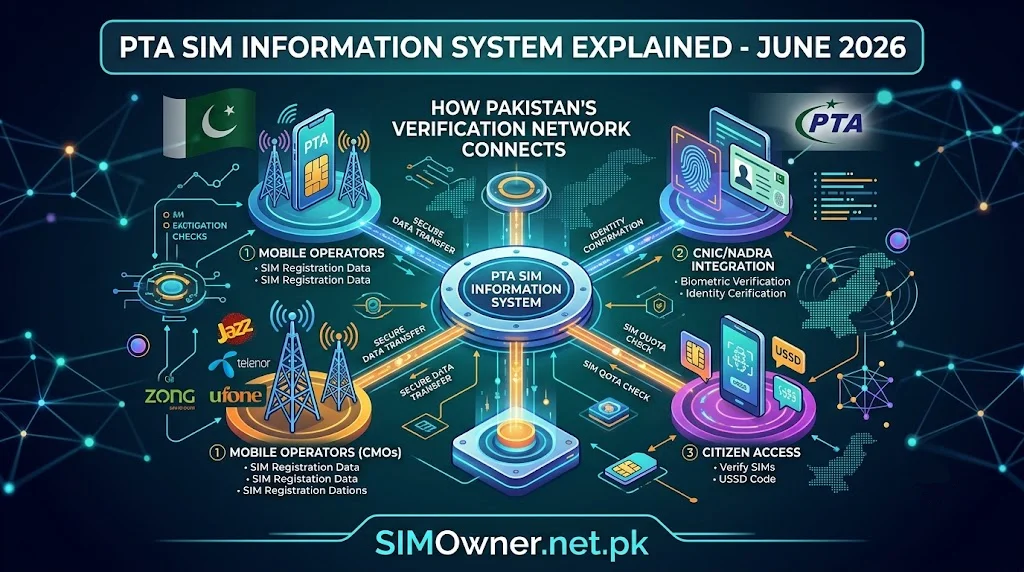
Pakistan’s SIM verification infrastructure is not one single system but an interconnected network of databases, biometric verification layers, and operator integrations working together. Understanding this complete ecosystem — not just the individual components like 668 or MBVS in isolation — gives you the full picture of how your SIM identity is protected, where the system’s strengths lie, and where gaps remain that fraud continues to exploit even in mid-2026.
This guide ties together every component of Pakistan’s SIM Information System into one comprehensive explanation: how PTA’s regulatory layer, NADRA’s biometric layer, and individual operator systems interact, what information flows between them, and how this complete architecture affects your personal SIM security in practical terms. Check your own position within this system right now at SimOwner.net.pk — seeing your actual SIM data makes this architectural explanation concrete rather than abstract.
The Three-Layer Architecture of Pakistan’s SIM Information System
Pakistan’s SIM verification ecosystem operates across three interconnected layers, each serving a distinct function:
Layer 1 — NADRA’s Identity and Biometric Layer
This is the foundational layer — NADRA maintains the national identity database (CNIC records) and the biometric verification system (MBVS) that confirms a person’s physical identity matches their claimed CNIC.
What this layer contains:
- CNIC issuance and renewal records
- Ten-finger biometric templates
- Facial recognition data
- Family registration linkages
- Deceased status flags
Layer 2 — PTA’s Regulatory and Aggregation Layer
PTA’s SVMS (Subscriber Verification Management System), as detailed in our dedicated SVMS guide, aggregates SIM registration data across all five licensed operators into a single queryable system.
What this layer contains:
- SIM-to-CNIC mapping across all networks
- Registration timestamps
- 8-SIM limit enforcement
- Compliance flags and fraud annotations
- Public query interfaces (668, cnic.sims.pk)
Layer 3 — Operator-Level Systems
Each of the five operators (Jazz, Zong, Telenor, Ufone, SCO) maintains its own subscriber management system handling billing, package management, customer service records, and the franchise-level registration interface where the actual SIM registration transaction occurs.
What this layer contains:
- Detailed account information (balance, packages)
- CDRs (call detail records)
- Franchise-specific registration logs
- Customer service interaction history
How a Single SIM Registration Flows Through All Three Layers
Understanding the complete transaction flow clarifies how the system is designed to prevent fraud — and where breakdowns occur:
Step 1 (Layer 3 — Operator): Customer presents CNIC at franchise. Franchise terminal captures CNIC number and initiates registration request.
Step 2 (Layer 1 — NADRA): Franchise terminal sends biometric query to NADRA MBVS with the captured fingerprint. NADRA compares against stored templates for that CNIC and returns Verified/Not Verified.
Step 3 (Layer 2 — PTA): If biometric is verified, the franchise system queries PTA’s SVMS to confirm the CNIC has not exceeded the 8-SIM limit.
Step 4 (Layer 3 — Operator): If both checks pass, the operator’s system completes the registration — activating the SIM and updating internal billing/account records.
Step 5 (Layer 2 — PTA): The operator’s system synchronizes the new registration to SVMS, making it visible in 668 and cnic.sims.pk queries within hours.
Where fraud occurs: The most common fraud vulnerability is at Step 2 — when a corrupt or careless franchise employee proceeds past Step 1 without an actual successful biometric match, falsely marking it as verified in their own system before Step 3 even occurs. This means SVMS (Layer 2) can end up showing a “registered” SIM that never had genuine biometric authorization — the exact discrepancy that FIA investigates in fraud cases.
June 2026 System Status — What Has Changed Recently
As of June 2026, several developments are relevant to understanding the current state of Pakistan’s SIM Information System:
Continued enforcement from January 2026 sweep: The aftermath of PTA’s major enforcement action continues to affect SIM registration patterns, with operators reporting stricter internal compliance monitoring as a direct response to regulatory pressure.
SIM replacement verification tightening: Following PTA’s 2026 directive requiring enhanced biometric verification specifically for SIM replacement transactions (not just new registrations), operators have been implementing updated franchise terminal software that enforces this requirement more rigorously at the technical level — making the historical “lost SIM replacement bypass” pathway progressively harder to exploit.
PDPA 2025 enforcement maturation: As Pakistan’s Personal Data Protection Authority continues to build out its operational capacity through 2026, the data protection obligations affecting how SVMS and operator systems handle subscriber data are becoming more concretely enforced, including breach notification requirements that affect the broader SIM Information System’s data security posture.
How Each Component Serves Different Security Functions
NADRA MBVS — Identity Confirmation
Primary security function: Confirms the physical presence and identity of the person registering a SIM.
Limitation: Only effective if franchise staff actually execute the query honestly — cannot prevent fraud where the query itself is bypassed or falsified at the point of entry.
PTA SVMS — Aggregation and Limit Enforcement
Primary security function: Prevents excessive SIM accumulation on a single identity and creates the cross-network visibility that powers 668 verification.
Limitation: Records what operators report — cannot independently verify that reported biometric status reflects what actually happened at the franchise.
Operator Systems — Transactional Record-Keeping
Primary security function: Maintains detailed transaction and usage records that become critical evidence in fraud investigations (CDRs, franchise logs, CCTV references).
Limitation: Quality and completeness of these records vary by operator and franchise — smaller third-party agents often have less robust record-keeping than directly-managed company stores.
Using the System’s Public Interfaces Effectively
668 SMS — The Universal Entry Point
As covered extensively throughout our guides, 668 is your direct window into Layer 2 (PTA’s SVMS). It is the fastest, most universal verification tool available to every Pakistani CNIC holder.
cnic.sims.pk — The Web Interface
Provides the same Layer 2 data with better formatting for documentation purposes — useful when building evidence for fraud complaints.
Operator Helplines — Layer 3 Detail Access
When you need information beyond what Layer 2 shows (registration dates, franchise locations, biometric verification flags), operator helplines and service centers give you access to their more detailed Layer 3 records.
NADRA Direct Access — Layer 1 Confirmation
For questions about your own biometric data quality or CNIC status independent of any specific SIM, NADRA Registration Centres give you direct access to Layer 1 information.
For comprehensive guidance combining all these access points, the SIM information resources at SimOwner.net.pk and SIM database verification tools provide the practical framework for navigating this multi-layer system effectively.
How the System Handles Cross-Layer Discrepancies
Understanding what happens when the layers disagree helps explain confusing situations you might encounter:
Scenario — Operator says “not registered” but 668 shows it registered: This indicates a Layer 3 (operator) vs Layer 2 (SVMS) discrepancy. Possible causes include sync delays, operator system migration issues, or in rare cases, a need for manual reconciliation. Resolution requires escalation to PTA, which has authority over both layers.
Scenario — Biometric verification was completed (Layer 1 confirms) but SVMS shows no record (Layer 2): This suggests a technical integration failure between the franchise system and SVMS — the registration transaction may not have fully completed or synchronized. This is a system error requiring operator-level technical investigation.
Scenario — SVMS shows “Verified” biometric flag but you never visited that franchise: This is the most serious discrepancy pattern — suggesting either franchise-level fraud (false marking of verification status) or, in rare cases, a genuine system anomaly. This requires formal FIA investigation, which can cross-reference Layer 1’s actual MBVS transaction logs against Layer 2’s recorded status.
What the Complete System Cannot Protect Against
Understanding the system’s architectural boundaries is as important as understanding its capabilities:
Social engineering remains outside the system’s scope entirely. No combination of NADRA, PTA, and operator system integration prevents a criminal from convincing you directly to share an OTP or 667 PAC code — this requires personal vigilance, not system architecture.
Pre-system data breaches remain a permanent vulnerability. CNIC numbers exposed in the 2019 and subsequent breaches remain usable by criminals for fraud attempts regardless of how robust the current three-layer system has become — the system can detect and prevent registration fraud at the point of attempt, but cannot retroactively un-expose breached data.
Insider threats at any layer create residual risk. A corrupt employee at a franchise (Layer 3), a compromised system integration (Layer 2), or in extremely rare cases, insider access at NADRA (Layer 1) each represent risks that technical architecture alone cannot fully eliminate — ongoing institutional oversight and individual monitoring remain necessary.
Practical Takeaways for Your Personal SIM Security
Given this complete system architecture, the most effective personal security practices remain consistent with what we have detailed throughout our guides:
- Monthly 668 checks — your direct, reliable window into Layer 2’s current state for your CNIC
- Network fraud flags — strengthening Layer 3’s handling of any future account change requests
- NADRA biometric currency — keeping Layer 1’s foundational data accurate and current
- NADRA fraud annotation — creating cross-layer enhanced scrutiny that propagates from Layer 1 through Layer 2
These four actions, executed together, engage with all three layers of Pakistan’s SIM Information System in a coordinated way — providing defense in depth rather than relying on any single layer’s protection alone.
Frequently Asked Questions
Q: Is there a single website where I can see all three layers of my SIM information at once?
A: No single public interface aggregates all three layers for individual access. 668 and cnic.sims.pk give you Layer 2 (SVMS). Operator helplines give you Layer 3 detail. NADRA gives you Layer 1 confirmation. Combining checks across these sources, as detailed in our SIM information guides, gives you the most complete personal picture currently available.
Q: Why doesn’t PTA just give individuals full access to all SVMS and MBVS data about themselves?
A: Privacy and security considerations limit how much raw system data is exposed even to legitimate CNIC holders — full MBVS transaction logs and franchise-level CCTV cross-references, for example, are investigation-grade data appropriately reserved for formal FIA processes rather than open public access, partly to prevent the kind of detailed system knowledge that could itself be misused by sophisticated fraudsters studying the verification process.
Q: Has the three-layer system changed significantly in 2026 compared to previous years?
A: The fundamental three-layer architecture has been stable since SVMS and MBVS were established, with 2026 developments focused on tightening enforcement (especially around SIM replacement verification) and improving data protection compliance under PDPA 2025, rather than fundamental architectural changes.
Q: Does this three-layer system apply equally to eSIM registrations?
A: Yes — as detailed in our eSIM security guide, eSIM registrations go through the same fundamental three-layer process (biometric verification, SVMS registration, operator account activation), with the primary difference being the delivery mechanism (digital profile vs physical card) rather than the underlying verification architecture.
Q: Can I request a complete audit of my own data across all three layers?
A: Under PDPA 2025’s access rights, you can formally request what data each layer’s controller (NADRA for Layer 1, PTA for Layer 2, individual operators for Layer 3) holds about you. This requires separate formal requests to each entity rather than a single consolidated audit mechanism, as the layers remain organizationally and legally distinct despite their technical integration.
Summary: Pakistan’s SIM Information System — Three Layers
| Layer | Operated By | Primary Function | Public Access |
|---|---|---|---|
| Layer 1 — Identity/Biometric | NADRA | Confirms physical identity match | NADRA Registration Centres |
| Layer 2 — Regulatory/Aggregation | PTA | Cross-network SIM count, registration record | 668, cnic.sims.pk |
| Layer 3 — Operator Systems | Jazz/Zong/Telenor/Ufone/SCO | Account details, CDRs, franchise records | Operator helplines/service centers |
For Pakistan’s most comprehensive SIM verification guidance across this complete ecosystem, visit Sim Owner Details — Pakistan’s trusted SIM information resource since 2015.
System architecture details based on publicly available PTA and NADRA regulatory documentation as of June 2026. SimOwner.net.pk is not affiliated with PTA, NADRA, or any network operator.
Related Guides on SimOwner.net.pk: