
Last Verified: June 2026 | By SimOwner.net.pk Editorial Team — Pakistan’s SIM registration technical specialists since 2015
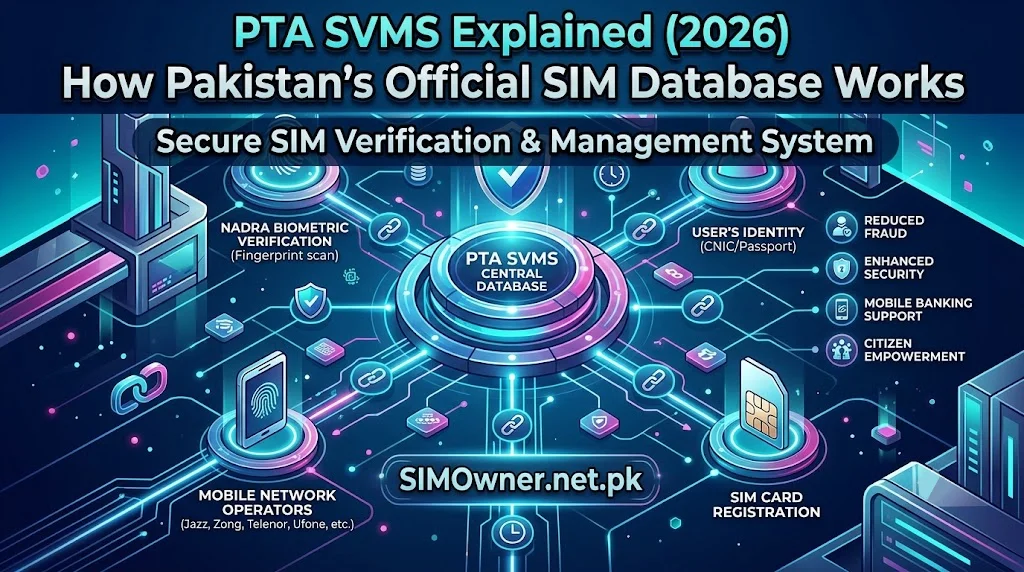
Every time you send your CNIC to 668 and receive a response listing your registered SIMs, you are querying a system most Pakistanis have never heard of by name: SVMS — the Subscriber Verification Management System. SVMS is PTA’s central database that aggregates SIM registration records from every Pakistani mobile network operator, creating the unified, cross-network view that makes services like 668 and cnic.sims.pk possible.
Understanding how SVMS actually works — its architecture, what data it contains, how it interacts with NADRA’s MBVS, and its role in fraud detection and enforcement — gives you a deeper appreciation for both the strengths and limitations of Pakistan’s SIM verification system. This technical understanding is directly useful: it helps you interpret your 668 results more accurately, understand why certain information is or is not available through public checks, and engage more effectively with PTA and operators when issues arise.
This guide provides the complete technical and functional explanation of SVMS. Check your own SVMS record right now at SimOwner.net.pk to ground this technical explanation in your own practical experience.
What Is SVMS — The Foundational Explanation
SVMS (Subscriber Verification Management System) is PTA’s centralized database infrastructure that maintains records of every active SIM registration across all licensed Pakistani mobile network operators. It was developed as part of Pakistan’s comprehensive telecom regulatory modernization, particularly accelerating after the 2015 National Action Plan mandated stronger SIM registration controls.
The Core Function of SVMS
Before SVMS-style centralization, each network operator maintained its own subscriber database in isolation. There was no easy way to determine, across all networks combined, how many SIMs a single CNIC holder had registered — making the 8-SIM limit difficult to enforce and creating blind spots that facilitated fraud.
SVMS solves this by creating a federated central registry: each operator’s subscriber registration system feeds data into SVMS in near-real-time, and PTA’s central system aggregates this data, making it queryable across all networks simultaneously.
SVMS Architecture — How the System Actually Works
Data Flow From Operators to SVMS
Step 1 — Registration at franchise level: When a SIM is registered at any franchise (Jazz, Zong, Telenor, Ufone, SCO), the operator’s local system captures the registration details: CNIC number, phone number, biometric verification result, registration timestamp, and franchise identifier.
Step 2 — Operator system processing: The operator’s central subscriber management system processes this registration, applying internal business rules (package assignment, billing setup, etc.).
Step 3 — SVMS synchronization: The operator’s system transmits the relevant subscriber verification data to PTA’s SVMS through a secure API integration. This synchronization happens in near-real-time — typically within minutes to a few hours of the original registration.
Step 4 — SVMS central record creation: PTA’s SVMS creates or updates the central record, associating the SIM number with the CNIC, operator, and registration metadata.
What SVMS Stores
| Data Field | Description |
|---|---|
| CNIC/NICOP number | The 13-digit identity number |
| SIM/MSISDN number | The phone number |
| Network operator | Which of the 5 licensed operators |
| Registration date | When the SIM was registered |
| Biometric verification status | Whether MBVS verification was completed |
| SIM status | Active, suspended, deactivated |
| Registration type | New, replacement, transfer |
What SVMS Does NOT Store Directly
SVMS is a registration and verification status system — it is distinct from:
- CDRs (Call Detail Records): Actual call/SMS/data usage logs remain with individual operators, not centralized in SVMS
- Financial transaction data: JazzCash, Easypaisa transaction records are entirely separate systems
- Biometric templates themselves: The actual fingerprint data remains in NADRA’s MBVS system — SVMS only records whether verification was successfully completed, not the biometric data itself
How 668 Queries SVMS
The 668 SMS service that millions of Pakistanis use is essentially a simplified public query interface to SVMS:
The query process:
- You send your CNIC via SMS to 668
- PTA’s system (connected to SVMS) receives this query
- SVMS searches for all SIM records associated with that CNIC number across all operators
- The system compiles a response listing all matching SIMs with their operator
- The response SMS is sent back to your phone
Why 668 cannot show registration dates or franchise details: The 668 service is intentionally simplified — providing only the essential count and number information for public-facing verification. More detailed SVMS data (registration date, franchise location) requires either operator-level inquiry (where the operator’s own more detailed records are accessed) or formal PTA/FIA data requests for the complete SVMS record.
SVMS and the 8-SIM Limit Enforcement
SVMS is the technical mechanism that makes Pakistan’s 8-SIM-per-CNIC limit enforceable in real-time:
At the point of new SIM registration:
- The franchise system queries SVMS to check the CNIC’s current registered SIM count
- If the count is already at 8, SVMS returns a rejection
- The franchise system blocks the registration from completing
This is why the 8-SIM limit is one of the more reliably enforced rules in Pakistan’s SIM ecosystem — unlike biometric verification (which depends on franchise staff actually completing the process correctly), the count check is a hard technical limit that the registration software itself enforces by querying SVMS before allowing the transaction to proceed.
For complete details on the 8-SIM limit and how to check your current count, see our comprehensive SIM limit guide.
SVMS and NADRA MBVS — The Critical Relationship
SVMS and NADRA’s MBVS (Multi-Biometric Verification System) are separate but tightly integrated systems:
MBVS’s role: Verifies that the person physically present at registration matches the biometric data on file for the claimed CNIC — this is the “is this really you” check.
SVMS’s role: Records the registration itself and tracks the aggregate count and status across all networks — this is the “how many SIMs does this CNIC have” check.
How they work together: During SIM registration, the franchise system first queries MBVS for biometric verification. If MBVS returns “Verified,” the franchise system proceeds to query SVMS to check the SIM count limit. If both checks pass, the registration completes and SVMS is updated with the new record (including a flag indicating biometric verification was successfully completed).
The fraud vulnerability point: If a franchise employee bypasses the MBVS check (through bribery or system manipulation) but still proceeds to register the SIM in SVMS, the SVMS record will show the registration but with an absent or falsified biometric verification flag. This is precisely the gap that FIA investigates when examining suspected fraudulent registrations — checking whether SVMS shows a registration without a corresponding genuine MBVS verification event.
For the complete explanation of MBVS specifically, see our dedicated NADRA MBVS guide.
SVMS in Fraud Investigation
When FIA investigates a reported SIM fraud case, SVMS data is one of the primary evidence sources:
What FIA can extract from SVMS for a specific SIM:
- Exact registration date and time
- Which operator’s franchise processed it (via franchise identifier)
- Whether biometric verification was flagged as completed
- Any subsequent status changes (suspensions, reactivations)
- Historical registration changes if the SIM has been re-registered or transferred
Cross-referencing with MBVS logs: FIA can request NADRA to provide the actual MBVS transaction log for the specific registration event timestamp — confirming whether a genuine biometric query was sent and what result it returned. Comparing this against SVMS’s recorded “verification status” flag can reveal discrepancies indicating fraud or system manipulation.
SVMS Updates and Propagation Timing
Understanding the timing of SVMS updates helps set realistic expectations when monitoring your SIM status:
| Action | Typical SVMS Update Time |
|---|---|
| New SIM registration | Minutes to a few hours |
| SIM deactivation (voluntary) | A few hours to 1-2 days |
| SIM deactivation (fraud-related, operator action) | Hours (often expedited) |
| Ownership transfer | A few hours to 1 day |
| Full removal from count after deactivation | 30-90 days (varies by operator) |
This explains why, after reporting a fraudulent SIM and having the operator confirm deactivation, your 668 check might still show the SIM for some time — the deactivation event itself is fast, but full removal from the active count can take longer as the records work through the operator’s and PTA’s reconciliation processes.
SVMS Data Accuracy — Known Limitations
While SVMS is a sophisticated and generally reliable system, understanding its limitations helps you interpret discrepancies correctly:
Operator reporting lag: If an operator’s system has technical issues, SVMS synchronization can be delayed, creating temporary discrepancies between what 668 shows and what the operator’s own records show.
Historical data quality: SIMs registered before SVMS’s full implementation (very old SIMs from the early 2010s or before) may have less complete metadata than recently registered SIMs.
Franchise-level data entry errors: Human error at the point of registration (incorrect CNIC entry, typos) can occasionally create SVMS records that do not perfectly match reality — though Pakistan’s biometric verification requirement substantially reduces this compared to systems relying purely on manual data entry.
SVMS and PDPA 2025 — Data Protection Considerations
As detailed in our PDPA 2025 guide, SVMS — as a government-maintained database containing sensitive personal information (CNIC numbers linked to phone numbers) — falls within the scope of Pakistan’s data protection framework.
PTA’s obligations regarding SVMS data:
- Implement appropriate security measures protecting SVMS from unauthorized access
- Limit SVMS data sharing to authorized purposes (operator verification, law enforcement investigation, individual CNIC holder’s own access)
- Maintain audit trails of who accesses SVMS records and for what purpose
Your rights regarding your own SVMS data: As covered under PDPA’s access rights, you can request information about your own SVMS records — which is effectively what you are doing every time you check 668 or visit PTA’s helpline for SIM registration confirmation.
Using SVMS Knowledge to Interpret Your SIM Checks
Understanding SVMS’s architecture helps you interpret what you see in practical checks:
When 668 shows a SIM: This confirms SVMS has a record linking that number to your CNIC — a reliable indicator of current registration status.
When the count seems wrong: Consider the propagation timing (a recent deactivation may not have fully processed) before assuming an error.
When investigating fraud: Knowing that SVMS records the registration event with a biometric verification flag helps you ask the right specific questions when calling operator fraud departments or filing FIA complaints — specifically asking whether the biometric verification flag for the suspicious SIM was properly set.
For ongoing practical SVMS-based verification, the SIM database tools at SimOwner.net.pk and SIM information resources provide the guidance framework for translating this technical understanding into effective personal SIM security practice.
Frequently Asked Questions
Q: Is SVMS the same thing as the 668 service?
A: Not exactly — 668 is a public-facing SMS query interface that retrieves data from SVMS. SVMS is the underlying database and system architecture; 668 is one of several ways to query it (cnic.sims.pk is another). Think of SVMS as the database and 668 as one application that reads from it.
Q: Can I directly access SVMS myself without going through 668 or cnic.sims.pk?
A: No — individual citizens do not have direct database access to SVMS. The public access methods are specifically the 668 SMS service and the cnic.sims.pk web portal, both of which provide a simplified, appropriately-scoped view of your own CNIC’s data. Operators have their own more detailed access for their subscriber records, and PTA/FIA have full system-level access for regulatory and investigative purposes.
Q: Does SVMS contain data from before Pakistan’s biometric verification requirement (pre-2015)?
A: SVMS contains records for SIMs that survived the 2015-2016 national re-verification campaign — SIMs that failed to complete this re-verification were deactivated and removed from active records. For SIMs registered and properly verified after 2015, SVMS data reflects complete MBVS-era registration information.
Q: If my SIM was registered by a previous owner and I now use it without transfer, does SVMS reflect my actual usage?
A: No — SVMS reflects the registered CNIC, not the actual user of the device. This is exactly why using a second-hand SIM without completing a formal ownership transfer creates the legal exposure discussed in our second-hand SIM risks guide — SVMS (and therefore all official verification) shows the previous owner as responsible, regardless of who is actually using the SIM.
Q: How does SVMS handle SIMs for deceased persons?
A: SVMS continues to show SIMs as registered to a deceased person’s CNIC until either the network operator deactivates them (upon family notification with death certificate) or NADRA formally updates the CNIC’s status as deceased, which propagates to SVMS to block any further registration attempts on that CNIC.
Summary: PTA SVMS Key Facts
| Aspect | Detail |
|---|---|
| Full name | Subscriber Verification Management System |
| Operated by | PTA (Pakistan Telecommunication Authority) |
| Function | Central registry of all SIM registrations across operators |
| Public access methods | 668 SMS, cnic.sims.pk |
| Works with | NADRA’s MBVS (biometric verification) |
| Enforces | 8-SIM-per-CNIC limit |
| Update timing | Minutes to hours for new registrations; 30-90 days for full count removal after deactivation |
| Used in fraud investigation | Yes — registration timestamps and verification flags |
For Pakistan’s most comprehensive technical understanding of SIM verification systems and practical fraud prevention tools, visit Sim Owner Details — Pakistan’s trusted SIM information resource since 2015.
Technical architecture details based on publicly available PTA regulatory documentation and operator integration standards as of June 2026. SimOwner.net.pk is not affiliated with PTA or any network operator.
Related Guides on SimOwner.net.pk: